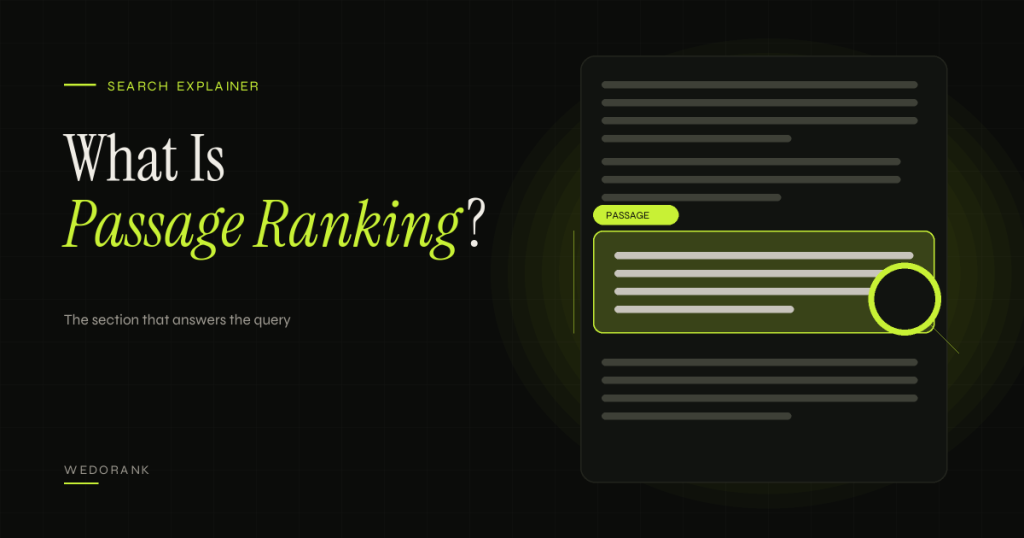
Long pages are normal. A good guide, a detailed comparison or a thorough FAQ can run to thousands of words and answer dozens of questions. The problem that passage ranking addresses is simple: what if the answer someone needs is one short section buried in the middle of a long page? A search engine that only judged pages as a whole might overlook it. Google describes passage ranking as a system that looks at individual sections of a page to better understand how relevant the page is to a search.
This guide explains what passage ranking is, what Google has and has not said about it, how it works at a conceptual level, and how to run a practical section-level content audit. It also corrects some persistent misunderstandings, because passage ranking is often described as something you can optimise with tricks. It is better understood as a reason to write clear, self-contained sections, which also makes content better for readers.
Key takeaways
- Passage ranking is a Google ranking system that evaluates individual passages within a page to judge how relevant the page is to a query. It matters most for specific questions answered in one section of a longer page.
- It is a ranking system, not a markup or a setting. There is no tag you add to enable it.
- The practical response is clarity: descriptive headings, sections that answer one question, and key facts stated inside the section that needs them.
- Passage ranking is a documented Google concept. Similar ideas, such as retrieval of passages by AI answer tools, are related but are not the same thing and should not be conflated.
- A section-level audit is a cheap, evidence-based way to find and improve weak passages. You can test the effect, though you cannot prove causation from one page.
How to read the evidence in this guide
We label claims as official documentation, established concept, practitioner convention or hypothesis. Passage ranking as a Google system is official documentation, although the finer details of how it works are not published. Advice about writing clear sections is a practitioner convention that is consistent with Google’s guidance to create helpful content but is not itself a documented ranking requirement.
What Is Passage Ranking?
Passage ranking is a Google system that identifies individual sections, or passages, of a web page in order to better understand how well the page matches what someone is searching for. Google announced the capability in 2020 and has listed it among its ranking systems. (Official documentation: A guide to Google Search ranking systems.)
The classic illustration is a very specific question, such as how to remove a particular kind of stain, where the best answer is a paragraph within a general cleaning guide. Without passage-level understanding, the guide may look only moderately relevant overall. With it, the relevant paragraph can lift the page’s match for that specific search.
Passage ranking is not passage indexing
A frequent misunderstanding is that Google indexes passages as separate documents. Google describes passage ranking as a ranking system that evaluates passages to understand how relevant a page is, and says its ranking systems are designed to work at the page level. For site owners the practical meaning is that you still publish and optimise whole, indexable pages. You are not asking Google to index a paragraph.
What it is not
- It is not a featured snippet. Featured snippets display an extract in the results. Passage ranking is about how a page is evaluated.
- It is not jump links or table of contents markup. Those can help readers and sometimes appear in results, but they are separate features.
- It is not key moments for video. That is a different system for video content.
- It is not the same as RAG or embedding-based chunk retrieval. Those are general AI retrieval techniques. They have a similar practical lesson, but the mechanics and the products are different.
Who should care
Anyone producing long-form content: guides, resource pages, documentation, comparison pages and FAQs. If your best answer to a question lives in the middle of a long page, this is the system that makes its structure worth caring about.
How Passage Ranking Works
Google has not published the algorithm, so the following is a conceptual model, labelled as such.
- A query arrives with a specific information need.
- The system considers candidate pages. This includes pages that match the topic broadly.
- Individual passages within each page are assessed for how well they address the need. (Official concept; the method is not published.)
- The passage-level understanding informs the page’s relevance. A page with a strong matching passage can be judged more relevant than its overall focus suggests.
- Other ranking signals still apply. Passage relevance is one input among many, including quality and reliability signals, so a great passage on a weak or untrustworthy page does not guarantee visibility.
| Element | What it does | What you can influence | Evidence status |
|---|---|---|---|
| Passage identification | Finds sections that address the query | Clear headings and one-topic sections | Official concept, method unpublished |
| Relevance assessment | Judges how well a section answers the need | Direct, specific, well-evidenced answers | Hypothesis for exact criteria |
| Page-level signals | Quality, reliability, links and more | The whole page and site | Official, broad |
| Presentation | Snippets, jump-to links and similar features | Anchors and structure | Separate features |
What makes a passage easy to understand
Again, this is practitioner guidance rather than a published specification, but it follows from how language models and readers both process text. A good passage states its subject by name, answers one question, includes the conditions and exceptions that make the answer accurate, avoids dependence on text elsewhere on the page and contains the terms a person would naturally use to ask the question.
A Real-World Example
This example is illustrative. It shows a before-and-after section audit with invented content. It does not use client data and should not be read as a result.
Imagine a long guide to redirects with a section titled “Other things to consider”. A reader searches for how long a 301 redirect should stay in place. The relevant text sits inside that section:
As mentioned, it depends. Keep it as long as it makes sense, and check the other points above.
This passage fails in several ways. The heading says nothing about the topic. The text relies on “as mentioned”. It names no subject, gives no answer and offers no condition. A system assessing the passage has almost nothing to match against the question.
A rewritten version under a descriptive heading might read:
How long should a 301 redirect stay in place? Keep a 301 redirect for as long as the old URL has links pointing to it or people still request it, which in many migrations means a year or longer. Removing a redirect too early can send visitors and crawlers to an error page. Check your server logs and backlink data before removing any redirect. [Sources and time frames to be verified before publication.]
The new version names the topic, gives a direct answer, states conditions and says what to check. It stands alone. In practice you should only publish figures such as “a year or longer” if you can support them, so always verify claims before including them.
Implementation Steps: A Section-Level Content Audit
- Pick the page. Choose a long page with decent impressions in Search Console, ideally one that ranks for the headline query but not for the specific questions it contains.
- List the sections. In a spreadsheet, record each H2 and H3 with its approximate word count.
- Name the question each section should answer. Write it as a real question. If you cannot, the section may lack a clear purpose.
- Score each section from 1 to 5 on five criteria: descriptive heading, direct answer in the first two sentences, subject named explicitly, conditions and evidence included, and independence from surrounding text.
- Check Search Console. Filter to the page and note queries that match specific sections but earn few impressions or have weak positions. These are your candidate improvements.
- Check live results. For two or three of those queries, inspect what ranks. Is the answer a short direct passage or a full page?
- Rewrite the lowest scoring sections. Keep the narrative flow, make each section answer its question, and remove filler.
- Add internal links from the sections to deeper pages where they exist and are live.
- Do not change unrelated parts of the page, so you can attribute any movement more clearly.
- Record the baseline and review date before publishing the update.
A scoring rubric you can copy
| Criterion | 1 (weak) | 3 (adequate) | 5 (strong) |
|---|---|---|---|
| Heading | Vague or clever | Related to the topic | States the question or subject precisely |
| Direct answer | None | Answer appears late | Answer in the first one or two sentences |
| Subject named | Relies on pronouns and “above” | Mostly named | Fully self-contained |
| Conditions and evidence | Absent | Partial | Conditions, source or example included |
| Independence | Meaningless alone | Mostly understandable | Fully understandable alone |
Free Tools
| Tool | Use | Limits and checks |
|---|---|---|
| Google Search Console | Find queries and pages with impressions; compare periods | Not every query appears; average position is aggregated; export data before it ages out |
| Google Sheets | Section inventory, scoring and change log | Needs consistent scoring by one reviewer or a shared rubric |
| Google Search | Check how live results answer the specific question | Results vary by location and personalisation; record date and locale |
| Browser find and heading outline extensions | Quickly see the heading structure | Choose reputable extensions and check permissions |
| An AI assistant such as Claude | Summarise each section to test whether its answer is clear, or draft rewrites for you to edit | Free usage limits apply. It will happily polish weak content, so judge the substance yourself and verify any facts. |
Limitations and Misconceptions
- You cannot see passage ranking in action. There is no report that shows which passage helped a page. Your evidence is indirect: query and impression changes.
- It is not a trick. Rewriting sections will not guarantee higher rankings. It improves usefulness and gives the system a better chance to understand relevance.
- Quality and trust still matter. A clear passage on a thin or unreliable page will not overcome weak page-level signals.
- Do not fragment the page. Turning a coherent guide into disconnected snippets can harm readers. Keep the story, clarify the sections.
- Do not duplicate answers across pages. Writing the same direct answer on many URLs to catch queries creates competing pages.
- Do not confuse it with other AI retrieval. Embedding-based retrieval in answer tools has a similar lesson, but evidence from one does not transfer automatically to the other.
- Small sample, many confounders. One page update proves little. Seasonality, links and updates can all move the numbers.
What Google Says About Structuring Content
Google’s guide to generative AI features says there is no requirement to break content into tiny pieces and no ideal page length, and that its systems can understand the nuance of several topics on a page and show the relevant piece to users. It also says people generally appreciate pages organised into paragraphs and sections with headings that give a clear structure. That fits the advice in this article: write clear, well-labelled sections because they help readers, and do not fragment a page for the sake of a machine. See the guide for the exact wording.
A Measurable Experiment
Hypothesis (unverified): Rewriting the weakest sections of a long page so each answers one question directly will increase impressions for the long-tail queries that match those sections, compared with similar pages left unchanged.
- Choose pages. Select four to eight long pages of similar type and age. Split them into a treatment and a control group.
- Run the audit on the treatment pages and select the three weakest sections on each.
- Record the baseline. Export 28 days, ideally eight weeks, of Search Console data for every page: queries, impressions, clicks and average position. Identify the target queries that correspond to the weak sections.
- Apply the rewrite to treatment pages only. Log the date and exact changes.
- Leave controls untouched and avoid changing their internal links.
- Observe for six to eight weeks, then export the same period length.
- Compare impressions and the number of distinct queries for the target queries, treatment versus control, and against the previous period.
Primary metrics: impressions for target queries; number of distinct queries per page. Secondary: clicks, average position for target queries. Guardrails: engagement and conversions on treated pages should not decline. Confounders: seasonality, updates to Google systems, new links, changes in the live results and small sample size. Interpretation: consistent gains on treatment pages beyond the control are encouraging evidence. Do not claim that you have proven a passage ranking effect, because many things could explain the difference.
Common Mistakes
- Adding a table of contents and calling it passage optimisation. Jump links help readers, but they do not make a weak passage clear.
- Writing questions as headings and then not answering them. A question heading followed by a vague paragraph is worse than a plain heading.
- Making every section the same length. Answer length should follow the question.
- Removing context readers need. Self-contained does not mean stripped of nuance.
- Skipping evidence. A direct answer with no support is easy to produce and easy to ignore.
Passage Ranking Compared With Related Concepts
These terms are often mixed up in conversation and in vendor marketing. Keeping them separate protects you from making claims you cannot support.
| Concept | What it is | Who runs it | What you can do |
|---|---|---|---|
| Passage ranking | A ranking system that assesses sections of a page to understand its relevance | Write clear, self-contained sections | |
| Featured snippet | A display feature that extracts an answer into the results | Provide a concise, direct answer where it genuinely helps the reader | |
| Jump links and anchors | Links that go straight to a section of a page | Your site, sometimes shown by Google | Use clear headings and stable anchors |
| Key moments | A system for identifying segments within videos | Applies to video content, not text pages | |
| Chunk retrieval in AI answer tools | Splitting text into pieces and retrieving the closest ones to ground an answer | Each AI product | The same writing habits help; the mechanics differ |
| Query fan-out | Generating related sub-queries to explore a question | Google says AI Overviews and AI Mode may use it | Cover the follow-up questions readers ask |
Applying the Audit to Common Page Types
The same rubric works across content, but each page type has its own typical weak spots.
- Long guides. The usual problem is a vague heading followed by a paragraph that circles the subject. Fix the heading first, then lead with the answer.
- Service pages. Visitors often want a concrete answer to a question such as what is included, how long it takes or what it costs. Make each of those a clearly labelled section with a real answer, not marketing language.
- Comparison pages. Tables are valuable, but they should be accompanied by a plain-text statement of the main conclusion so the reasoning is not locked inside cells.
- Glossary and definition pages. Start with a one or two sentence definition that names the term, then add detail, examples and related concepts.
- FAQ pages. Each answer should be complete without “see above”. If an answer needs a long explanation, link to the page that gives it and still give a short, accurate answer on the spot.
- Documentation and how-to pages. State prerequisites in the step that needs them and describe the expected result, so each step is understandable on its own.
A Pre-Publish Checklist for Clear Sections
- The heading states the subject or the question.
- The first sentence contains the answer.
- The subject is named, not referred to as “it” or “this”.
- Any number, date or condition needed to interpret the answer is in the same section.
- Claims that need support are sourced or flagged for verification.
- The section can be quoted on its own without misleading.
- The section covers one question and does not wander.
- Internal links point only to pages that are live.
- The page remains a coherent read from top to bottom.
- You have recorded the change and the date so you can review the outcome.
How to Explain This to a Client or Stakeholder
Non-specialists tend to ask whether passage ranking means you should “optimise for it”. A defensible explanation is short: Google has said it looks at sections of a page as well as the page as a whole, so we make each important section clear and complete, which also helps readers. We cannot see or measure the system directly, so we run a controlled before-and-after test on a small set of pages and report what we observe, including the limits of what that test can show.
That framing keeps expectations realistic. It avoids promising rankings, it explains the work in terms of reader benefit and it gives the client a clear way to judge whether the effort was worthwhile.
Frequently Asked Questions
Does passage ranking mean I should split long pages into short ones?
No. The system exists so long pages can be judged on the strength of relevant sections. Split a page only when the topics genuinely serve different intents, and check your existing URLs before creating new ones.
How long should a passage be?
There is no verified ideal length. A passage should answer one question completely and stop. Judge by completeness, not word count.
Do I need special markup for passage ranking?
No. It is not controlled by markup. Clear structure and writing are the levers.
Is passage ranking the same as featured snippets?
No. Featured snippets are a display feature. Passage ranking concerns how pages are evaluated. A passage that is clear may also be suitable for a snippet, but they are different things.
Does this matter for AI Overviews?
Google says its AI features can use techniques like query fan-out and retrieve results across subtopics. Clear, self-contained sections are useful in that context too, but passage ranking as a named system should not be assumed to describe how those features work. See our guide to AI Overviews for background.
How can I tell if it worked?
Watch impressions and distinct queries for the target queries in Search Console, compare with controls, and give the update several weeks. Treat the result as evidence, not proof.
Sources and Further Reading
- Google Search Central: A guide to Google Search ranking systems
- Google Search Central: AI features and your website
Related reading
- Keyword vs vector vs hybrid search
- The on-page SEO checklist
- What is RAG? A guide for SEO professionals
Next Step
If you would like your longest, most important pages audited section by section, with a prioritised rewrite list, request a free SEO audit and tell us which pages matter most.